
Gemstones seem indestructible, but that is only half true. A diamond is the hardest thing there is and can still split. An emerald can lose its clarity in a steam cleaner. And a pearl is so soft that perfume alone damages it. If you know what each stone can’t handle, you can enjoy it for years.
How to store and clean jewellery is covered in How to store jewellery and How to clean jewellery. This article goes deeper into the stones themselves.
Hardness, toughness and cleavage
Three properties matter for gemstones:
- Hardness is how well a stone resists scratches. It is measured on the Mohs scale, from 1 to 10. The scale is not even: diamond (10) is many times harder than corundum (9).
- Toughness is how well a stone resists a knock. A hard stone is not automatically tough.
- Cleavage means a stone can break along a fixed plane, like wood along the grain. Topaz has such a plane and can split from a hard knock or a sudden change in temperature. Diamond can also break along a cleavage plane, and tanzanite, moonstone and kunzite are sensitive too. That is why the last two are better suited to pendants and earrings than to rings.
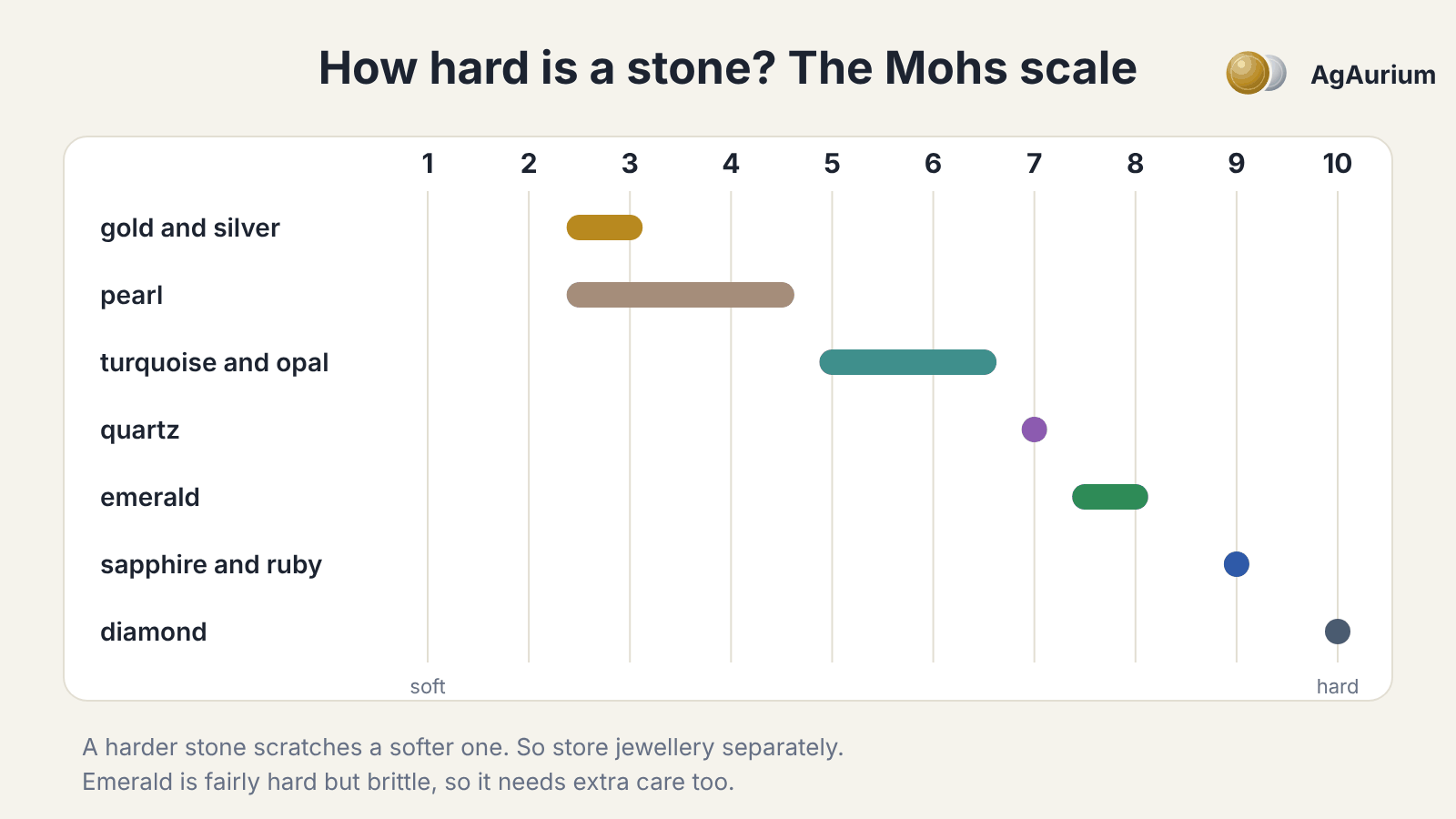
Stone by stone: what to watch out for
| Stone | Mohs | Sensitive to |
|---|---|---|
| Diamond | 10 | A hard knock on a cleavage plane. Attracts grease, so quickly turns dull. |
| Ruby and sapphire | 9 | Little. But glass-filled rubies can’t handle acid, not even mild acid. |
| Topaz | 8 | Knocks and changes in temperature (cleavage). Yellow to brown topaz can fade in sunlight or heat. |
| Emerald | 7.5 to 8 | Almost always treated with oil or resin. No heat, steam or ultrasonic. |
| Quartz, such as amethyst and citrine | 7 | Amethyst can fade in bright light. |
| Tourmaline | 7 to 7.5 | Irradiated tourmaline can fade from heat or bright light. |
| Garnet | 6.5 to 7.5 | Knocks if it has small cracks. |
| Tanzanite | 6 to 7 | Knocks, changes in temperature. Sometimes coated. |
| Opal | 5 to 6.5 | Drying out, heat and sudden changes in temperature. Can develop fine cracks (crazing). |
| Turquoise | 5 to 6 | Is porous. Absorbs skin oils, cosmetics and cleaning products. |
| Lapis lazuli | 5 to 6 | Often dyed and finished with wax. No heat and no solvents. |
| Pearl | 2.5 to 4.5 | Acids, cosmetics, sweat, drying out. |
| Amber | 2 to 2.5 | Scratches, heat. Can darken in light. |
Sources: the care advice per stone of the Gemological Institute of America (GIA).
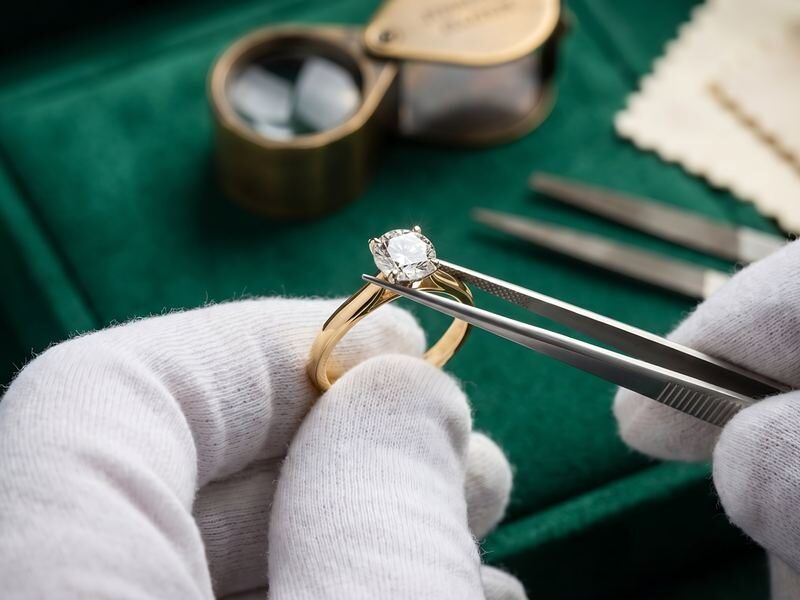
Treated stones
Many gemstones are treated to improve their colour or clarity. That is normal and need not be a problem, as long as it is disclosed honestly. But it does determine how you care for the stone.
- Heating is the most common treatment for ruby and sapphire. A heated stone is just as strong as an untreated one.
- Oil or resin for emerald. According to the GIA, well over 90 percent of all emeralds are treated this way. Heat, steam, solvents and even bright light can affect the filling. Then small cracks suddenly become visible.
- Glass filling for ruby. Cracks are filled with lead glass. Such stones are much more fragile: no acid, no ultrasonic, no steam.
- Irradiation for tourmaline and blue topaz, among others. With some stones the colour can fade from heat or light.
- Dyeing and coating are used on lapis lazuli, turquoise, tanzanite and topaz, among others. A coating can wear off through rubbing or strong products.
When buying an expensive stone, always ask whether and how it has been treated, and have that stated on the invoice or certificate.
Tip: For each stone, record the type, number, weight in carats, cut, colour and clarity in AgAurium, and keep the certificate as proof of purchase. Put the report number in the notes. Try AgAurium for free →
Light and heat
- Bright sunlight can make amethyst, kunzite and yellow to brown topaz fade. Don’t leave such jewellery on a windowsill or in a shop window.
- Amber, on the other hand, can darken in light.
- Opal contains water. Heat or dry air can make it dry out and crack.
- Sudden changes in temperature, such as from a warm hand into cold water, can make stones with internal stress or cleavage crack.
Pearls: the most sensitive of all
A pearl is not a stone, but is made by a mollusc. The lustrous layer is called nacre: thin layers of calcium carbonate (aragonite) with a protein in between. That layer is soft and sensitive to acids. Even sweat, perfume and hairspray damage it.
- Last on, first off. Put pearls on after perfume, make-up and hairspray.
- Wipe them after wearing with a soft, slightly damp cloth. Let a string dry flat, because wet silk stretches.
- Have a string restrung. The GIA recommends doing this every year for a string you wear often. Other sources say once every one to two years. If the thread between the pearls is visibly stretched or dirty, it is definitely time.
- A knot between each pearl stops them rubbing against each other. And if the string breaks, you lose one pearl at most.
- Don’t store them too dry. No silica gel and no airtight plastic for long periods.
Carats, the 4 Cs and certificates
For gemstones, a carat (ct) is a weight, not a fineness as it is for gold. One carat is 0.2 grams, divided into 100 points. So a 50-point diamond weighs half a carat, 0.1 grams.
For diamonds, quality is described with the 4 Cs: carat (weight), colour, clarity and cut (quality of the cut). The GIA devised this system in the 1940s. The colour scale from D (colourless) to Z has existed since 1953.
A certificate or grading report from an independent lab, such as GIA, HRD or IGI, describes the properties of a stone: weight, dimensions, colour, clarity, shape and any treatments. It is not a valuation: there is no price on it. With GIA you can check a report online using the report number. Keep such a certificate carefully with the piece.
An example: an engagement ring with 0.24 carat
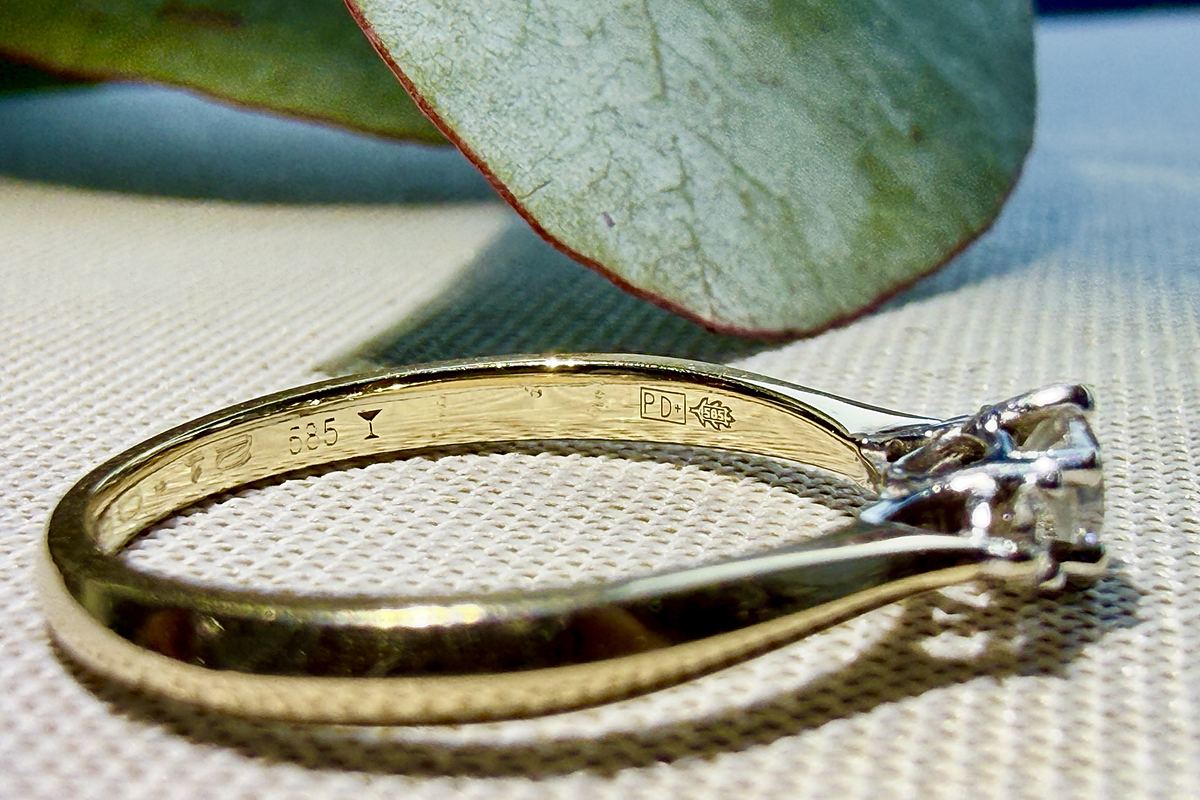
The product details of this ring by Excellent Jewelry say: 0.24 ct, brilliant, H/SI-1 (Wesselton). This is how to read that:
- 0.24 ct: the diamond weighs 24 points, about 0.05 grams. A brilliant of that weight is about 4 millimetres across.
- H (Wesselton): the colour. H is in the “near colourless” group and looks white to the eye. Wesselton is the older European name for this colour.
- SI-1: the clarity, *slightly included*. Under a 10x loupe you can see small inclusions, but usually not with the naked eye.
- Brilliant: the cut, the familiar round stone with 57 or 58 facets.
The ring weighs 2.0 grams in total. In AgAurium you enter only the gold: without the stone that is about 1.95 grams. At 585 gold, the fine weight is then about 1.14 grams (1.95 × 0.585).
How AgAurium helps
With jewellery set with stones, it is easy to forget the details. How many small diamonds are in that ring, and how much did they weigh? In AgAurium you record for each stone or pearl the type, the number, the weight in carats, the cut, the colour and the clarity. You keep the certificate as proof of purchase, visible only to you. In the notes you put the report number and any treatments. For the metal, enter the weight without the stones. AgAurium calculates the fine weight from weight × fineness and does not subtract the stones itself.
AgAurium is free and has no adverts. It is made possible by donations.
Keep track of your collection with AgAurium
Coins, bars, banknotes, stamps and jewellery in one overview, with photos, live metal prices and proofs of purchase. Free, without ads, in English, Dutch and German. Your data stays yours.