
Turn a ring over or look at the clasp of a chain and you will often find a few tiny marks. A number, some letters, sometimes a small symbol. Together they tell you what metal the piece is made of, who is responsible for it and whether it has been independently tested. In this article you will read how to decode them.
Use a 10x loupe and good light. Marks are usually on the inside of a ring, on or next to the clasp of a chain, on the bail of a pendant or on the back of a brooch.
1. The fineness mark: how much precious metal is in it?
The most important number is the fineness, in parts per thousand. 375 means that 375 of every 1,000 parts are gold, so 37.5 per cent. The rest is another metal, such as silver or copper.
| Metal | Common finenesses | Also written as |
|---|---|---|
| Gold | 375, 585, 750, 916, 990, 999 | 9ct, 14ct, 18ct, 22ct, 24ct; Au375, Au750 |
| Silver | 800, 925, 958, 999 | Sterling (925), Britannia (958), Ag925 |
| Platinum | 850, 900, 950, 999 | Pt950, Plat |
| Palladium | 500, 950, 999 | Pd950 |
A few things worth knowing:
- 14 carat is exactly 583.3, but the stamp almost always says 585. On older or foreign pieces you sometimes see 583.
- ct, K or kt stands for carat, the fineness of gold in 24 parts. Read more about converting between them in How to calculate fine weight, fineness and carat.
- Au, Ag, Pt and Pd are the chemical symbols for gold, silver, platinum and palladium.
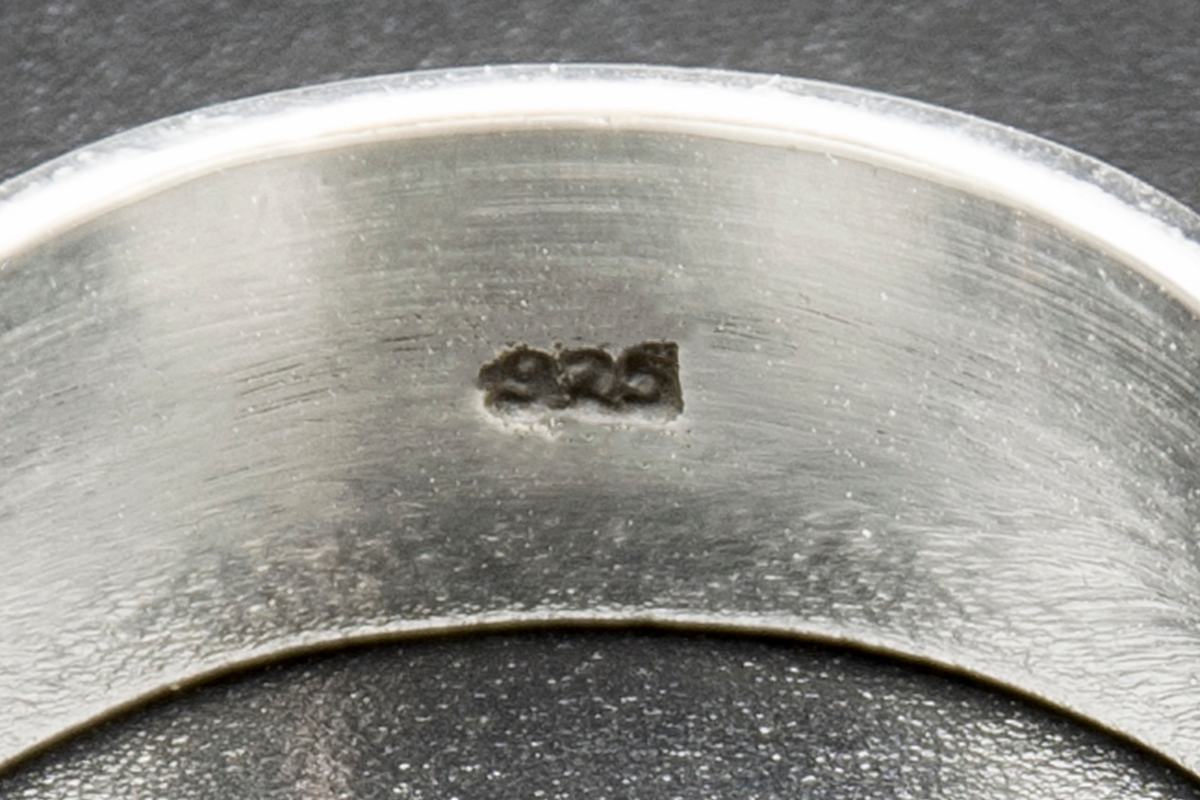
- A mark can be punched or laser-applied. Modern rings often have very crisp laser marks on the inside, like the ring below.

2. UK hallmarking: what is compulsory?
In the UK, hallmarking is a legal requirement under the Hallmarking Act 1973. Any item sold as gold, silver, platinum or palladium must be hallmarked by one of the four Assay Offices, unless it is below the exemption weight. This applies to shops and online sellers alike. A maker can never apply a hallmark themselves.
Exemption weights: gold 1 g, silver 7.78 g, platinum 0.5 g and palladium 1 g. Items at or below these weights do not need a hallmark.
A UK hallmark has three compulsory marks:
| Mark | What it tells you |
|---|---|
| Sponsor’s mark | Who sent the item for hallmarking, the maker or importer. At least two letters inside a shield. |
| Fineness mark | The fineness in parts per thousand, inside a shape that shows the metal. |
| Assay Office mark | Where it was tested: a leopard’s head (London), an anchor (Birmingham), a rose (Sheffield) or a castle (Edinburgh). |
On top of that there are optional marks:
- The date letter. It was compulsory until 1999 and has been voluntary since then. The letter changes on 1 January each year and is the same at all four offices. A new alphabet started in January 2025.
- Traditional pictorial marks, such as the lion passant for sterling silver (a lion rampant if marked in Edinburgh), Britannia for 958 silver, a crown for gold, an orb for 950 platinum and the head of Pallas Athene for palladium.
Every dealer in precious metal must display the Dealer’s Notice of the British Hallmarking Council, in the shop and on their website. It shows what the marks mean.
3. The international scales mark
Many items carry a small pair of scales with a number next to it. That is the Common Control Mark (CCM) of the Hallmarking Convention. The outline around it shows the metal and the number is the fineness. Member countries recognise each other’s mark. The UK has been part of the Convention since it began in 1972, together with countries such as the Netherlands, Ireland, Austria, Switzerland and the Scandinavian countries. Germany is not a member.
An item with a CCM from a member country can be sold in the UK without a separate UK hallmark. The scales mark always appears with the mark of the testing office and a sponsor’s or responsibility mark.
Tip: Use one of the two photos in AgAurium for a close-up of the marks, and write what you see in the notes, for example “375, anchor, sponsor’s mark AB, date letter”. Then you will not have to get the loupe out again next time. Try AgAurium for free →
4. Other countries in brief
- Germany: there is no compulsory hallmarking. The maker or seller applies the fineness in thousandths and is responsible for it being correct. That is why many German rings only say “585” or “Au375”. On German silver from after 1888 you sometimes see a crescent moon with a crown.
- The Netherlands: hallmarking is compulsory, with a minimum fineness of 585 for gold, 800 for silver and 850 for platinum. Old Dutch silver often carries a small lion with a number for the fineness class.
5. Marks that mean a thin layer
Some marks mean there is very little precious metal. The gold or silver is only a thin layer over another metal. In the UK such an item may not be described as gold or silver without making that clear.
| Mark | Meaning |
|---|---|
| GP (gold plated), GE (gold electroplate) | A very thin layer of gold, usually applied by electroplating |
| HGE (heavy gold electroplate) | A slightly thicker plating, but still a layer |
| GF (gold filled), RGP (rolled gold plate) | A thicker layer of gold bonded onto another metal |
| Vermeil | Silver with a layer of gold |
| EP, EPNS | Electroplated, often silver plate on nickel silver |
| Nickel silver, German silver, alpaca | An alloy of copper, nickel and zinc, with no silver in it |
If you see a fineness together with one of these marks, such as “14K GF” or “18K GP”, the number describes the layer, not the whole piece.
6. Is a mark a guarantee?
Not always. A hallmark from an independent Assay Office is a strong guarantee. A lone 925 or 585 without any other mark is not: anyone can punch a number into a piece of metal, and fake stamps exist. If in doubt, have the piece tested. Read more in How to tell if gold and silver is real or fake.
Recording hallmarks in AgAurium
You read a hallmark properly once, and after that you do not want to keep doing it. In AgAurium you enter the material and the fineness of each piece, or the carat for gold. For a common carat, such as 9 or 18, AgAurium converts it to the hallmark value (375 or 750). Put everything else you see in the notes, such as the sponsor’s mark, Assay Office and date letter. You can keep a close-up of the marks as the second photo. That helps with insurance, when you sell and for whoever inherits the piece.
AgAurium is free and has no adverts. Find it useful? A donation helps keep it free.
Keep track of your collection with AgAurium
Coins, bars, banknotes, stamps and jewellery in one overview, with photos, live metal prices and proofs of purchase. Free, without ads, in English, Dutch and German. Your data stays yours.