
Two coins of the same type and the same year can differ in value many times over. The same goes for banknotes and stamps. The difference almost always lies in the condition: how much wear, folding or damage an item has. If you know the abbreviations and can do a bit of assessing yourself, you buy more wisely and have a better idea of what your collection is worth.
Why condition matters so much
With collectables, condition largely determines the price. A coin that has never been in circulation is scarcer than one that spent years in people’s purses. That difference grows the older or rarer an item is.
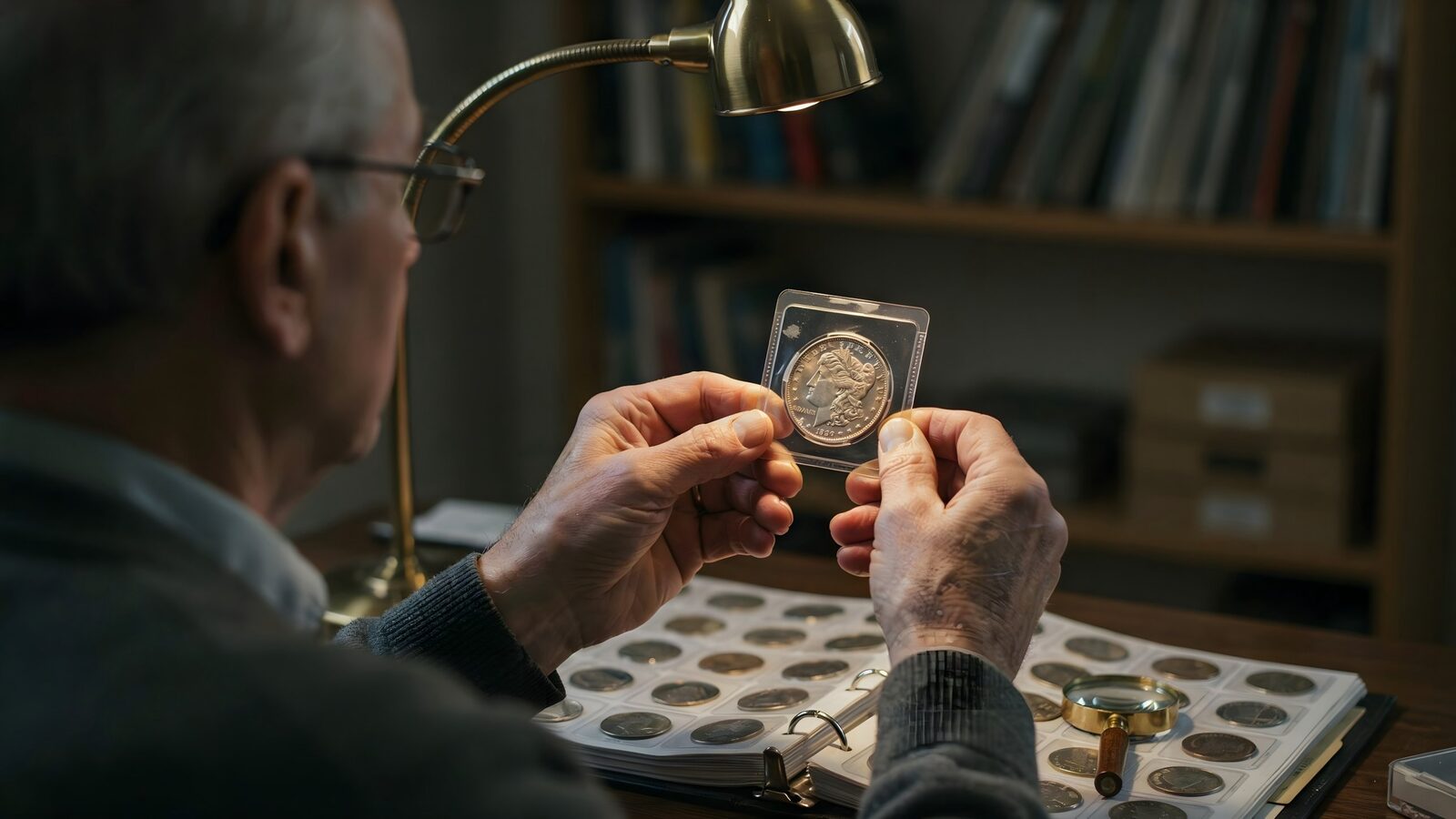
With bullion coins and bars, it is mainly the metal that counts. Condition plays a smaller role there, although a coin with scratches or spots sometimes fetches a little less when you sell it.
Coins: from proof to G
For coins, dealers and catalogues around the world use the same English abbreviations. In Dutch catalogues you will often see Dutch terms alongside them, such as prachtig for XF and zeer fraai for VF.
| Abbreviation | Meaning | What you see |
|---|---|---|
| Proof (PP) | Special striking quality | Struck with polished dies, often with a mirror-like field and frosted relief. Intended for collectors. |
| BU | Brilliant uncirculated | Carefully struck, fresh lustre, never in circulation. Often in a blister pack or case. |
| UNC | Uncirculated | No wear from use. Small knocks from the production process are possible. |
| AU | About uncirculated | Very light wear, only on the highest points of the relief. |
| XF (EF) | Extremely fine | Light wear on the highest points. All details still sharp. |
| VF | Very fine | Clear wear on the high areas, but the main details are easy to see. |
| F | Fine | Considerable wear. The design is clear, but fine details have flattened. |
| VG | Very good | Heavily worn. Outlines visible, many details gone. |
| G | Good | Very heavily worn. Only the main outlines and the most important lettering can still be read. |
Note: proof is not a grade of wear but a method of striking. So a proof coin can also be damaged. And in this list, “good” actually means poor condition.
The Sheldon scale
In the United States, the Sheldon scale is widely used, with numbers from 1 to 70. A 70 is a coin without any visible imperfection, even under magnification. Uncirculated coins score 60 or higher, with the prefix MS (mint state). Proof coins get PF or PR. This scale is used by grading services such as NGC and PCGS. In Europe you mainly come across it on graded coins.

Banknotes: count the folds
With banknotes, grading is all about folds, creases, edges and corners. The abbreviations are the same as for coins, but the meaning is different:
- UNC: perfect. Not a single fold, sharp corners, fresh colours. A note with one fold is by definition no longer UNC.
- AU: almost perfect. At most one light fold in the centre or a light counting crease in a corner, but not both.
- XF: lightly used. Up to three light folds or one hard fold. The paper is still crisp.
- VF: more used. Several folds lengthways and widthways, but the paper is still reasonably firm.
- F: well circulated. Many folds and creases, soft edges, possibly small tears in the edge.
- VG: heavily used, limp paper, rounded corners. Tears may run into the design, but nothing is missing.
- G: very heavily used, with many folds, tears and sometimes stains or writing.
A note that has been washed, pressed or ironed to get rid of folds is often spotted by experts and valued lower. See also How to store banknotes without damage.
Stamps: gum, centring and perforations
With stamps, you first look at the state of the gum:
- Mint never hinged: unused, with undisturbed original gum.
- Unused (hinged): never used for post, but with a hinge mark on the back.
- Used/cancelled: used for post, with a postmark.
The centring also counts (is the design neatly in the middle, with even margins?), as do the perforations (are all the teeth complete and not folded over?). Thin spots, small stains and folds lower the value too. For used stamps, how clear and neat the postmark is also matters. You can read more about this in Storing and handling stamps.
Tip: Choose the condition of each item in AgAurium and add a photo. The list adapts to the type of item, from proof to G for coins and from mint never hinged to used for stamps. Try AgAurium for free →
Jewellery: simpler
There is no fixed international scale for jewellery as there is for coins. A simple classification is usually enough:
- New: unworn, often still in its original packaging.
- Good: worn, but without visible damage.
- Used: clear signs of wear, such as small scratches or a slightly misshapen ring.
- Damaged: a loose or missing stone, a break or a broken clasp.
For gemstones, colour and clarity are assessed separately, independently of the condition of the piece itself.
Cleaning lowers the condition
It is tempting to give a spotty coin a quick polish. Don’t. Polishing removes a thin layer of metal, leaves fine scratches and changes the lustre. Experts see it immediately. A polished coin often receives a lower grade than a coin with natural toning, and grading services note cleaning on the label.

The same applies to banknotes that have been washed and stamps whose gum has been replaced.
Graded: coins and banknotes in a slab
If you want certainty about the condition, you can have a coin or banknote graded by an independent company. For coins, NGC and PCGS are well-known names, and for banknotes PMG. The item is graded, checked for authenticity and sealed in a rigid holder: a slab. The label shows the grade and a unique number that you can check online.
This costs money, so it mainly makes sense for more expensive items. Never open a slab: if you do, the grade is lost. You can read more about slabs in Capsules, seals, slabs and sleeves explained.
When you grade something yourself, always do it in daylight or under a daylight lamp, with a 10x loupe, and tilt the item so the light falls on it from different angles. That way you see wear, small scratches and folds you would otherwise miss.
How AgAurium helps
In AgAurium you choose the condition of each item. The list adapts to the type of item. For coins and bars you choose from proof, BU, UNC, AU, XF, VF, F, VG and G. For banknotes from UNC down to G. For stamps from mint never hinged, unused (hinged) and used/cancelled. For jewellery and other objects from new, good, used and damaged.
With photos of the front and back, you record what condition an item was in when you bought it. If you later wonder whether a scratch or fold has appeared, simply compare it with the photo. You can also show condition as a column in your overview and sort by it, so you can quickly see which items are worth having graded.
AgAurium is free and ad-free. A donation helps keep it that way.
Keep track of your collection with AgAurium
Coins, bars, banknotes, stamps and jewellery in one overview, with photos, live metal prices and proofs of purchase. Free, without ads, in English, Dutch and German. Your data stays yours.