
Most damage to jewellery doesn’t happen while you wear it, but in the drawer. Rings rub against each other, necklaces get tangled and silver turns black. Storing it properly prevents most of that. This article explains how.
Want to know how to clean jewellery, or how to deal with heat, light and treatments for each gemstone? Read How to clean jewellery and Caring for gemstones and pearls.
Why jewellery damages other jewellery
Materials vary greatly in hardness. The harder material scratches the softer one. This is often expressed on the Mohs scale, from 1 (very soft) to 10 (the hardest).
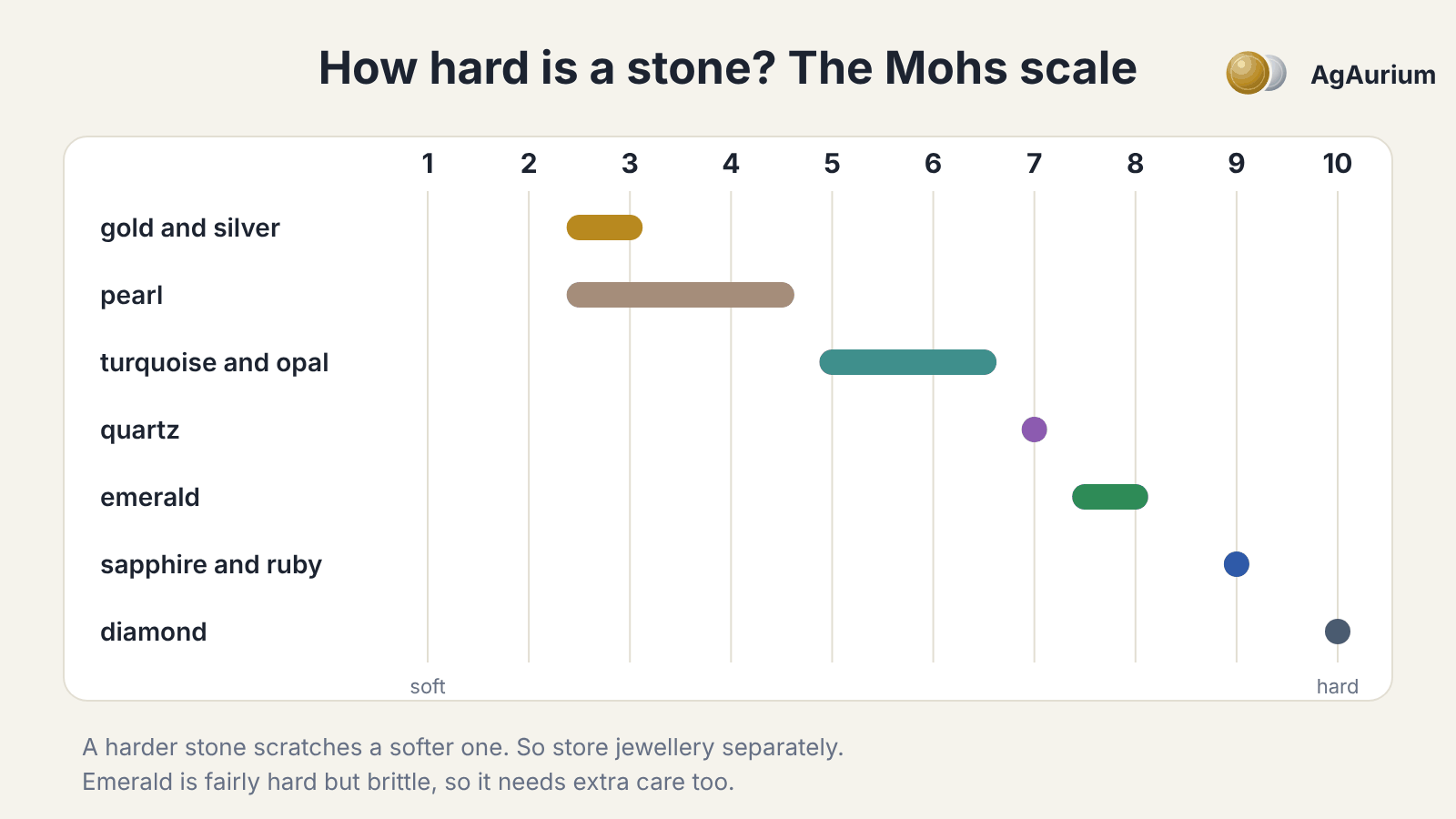
Gold and silver are around 2.5 to 3. So a diamond (10) scratches everything: your other stones, but also the gold of your rings. Even ordinary household dust contains quartz particles (7) that dull softer stones and metal.
The scale is not even. The difference between 9 and 10 is much bigger than between 4 and 5. And hard is not the same as strong: a stone can be hard and still split if it takes a knock. There is more on this in Caring for gemstones and pearls.
The basics: a place of its own for every piece
- Use a jewellery box with compartments, or a soft pouch for each piece. Never leave jewellery loose in a heap.
- Rings go in a ring roll or a slotted compartment, so they stand upright and don’t rub against each other.
- Earrings in pairs, in a compartment or on a card. That way none go missing.
- Bracelets flat in a compartment, or over a stand. Don’t hang heavy chain bracelets over a narrow hook.
- Jewellery with stones is best stored with the stone facing up, so the stone doesn’t press against the bottom or another piece.
Necklaces without knots
A fine chain that gets tangled is sometimes almost impossible to undo, and pulling at it causes a kink or a break.
- Fasten the clasp before you put the necklace away.
- Hang necklaces up on a hook or stand, or lay them out straight in a long compartment.
- Use a drinking straw when travelling. Thread the necklace through it and then fasten it. That keeps it straight.
- If it does get knotted, lay the necklace flat and gently work the knot loose with two pins. Never pull on the ends.
Silver turns black: how to prevent it
Silver tarnishes because of sulphur compounds in the air. A dark layer of silver sulphide forms. This happens faster when it is damp and when silver is close to materials that give off sulphur.
- Keep silver sealed away, each piece in a polythene bag or in a box that closes well.
- Use anti-tarnish cloth or strips. They absorb sulphur from the air before the silver does. Replace them as instructed.
- Add a sachet of silica gel. Drier air slows down tarnishing. Don’t do this with pearls and opal, see below.
- Avoid rubber, latex and felt near silver. They contain sulphur. Also watch out for old rubber bands and rubber seals in boxes.
- Simply wear your silver. A piece that is worn often and wiped with a soft cloth tarnishes less.
If it has turned black anyway, read How to clean jewellery to find out how to remove it safely.
Tip: Give every piece of jewellery a storage location in AgAurium, such as “jewellery box, compartment 3” or “safe deposit box”. Then you always know where it is, even if you haven’t worn it for a while. Try AgAurium for free →
Pearls and opal: not too dry
Where silver benefits from dry air, pearls and opal actually need a little moisture. They can dry out, turn dull or crack.
- No silica gel with pearls and opal.
- Not in plastic for long periods. A soft fabric pouch is better. Over time, plastic can dry pearls out.
- A bank safe deposit box is often very dry. In the long term that is not a good place for pearls and opal. Check them now and then, or keep them at home.
- Store a string of pearls flat. If you hang it up, the silk thread stretches.
Everyday wear: last on, first off
A lot of damage happens in everyday life:
- Put jewellery on last, after perfume, hairspray, make-up and cream. Those substances leave a film and attack pearls and soft stones.
- Take it off first, before you exercise, garden, clean or go to sleep.
- Not in the swimming pool or sauna. Chlorine can attack gold alloys. White gold containing nickel and prongs under heavy strain are especially vulnerable.
- Take rings off when washing up and put them in a fixed place, not on the edge of the sink.
Safe, safe deposit box and travelling
- A safe at home is good protection against burglary, but watch out for moisture. A fire-resistant safe in particular can become damp. Use silica gel for silver and gold, but not with pearls and opal. Read more in The best place to store your collection.
- A bank safe deposit box is secure, but dry. Fine for gold, platinum and hard stones.
- When travelling: only take what you will wear, store each piece separately in a travel case with compartments and keep jewellery in your hand luggage.
How AgAurium helps
If you have several jewellery boxes, a safe and perhaps a safe deposit box, after a while you no longer know exactly what is where. In AgAurium you give each piece of jewellery a storage location, you can search on it, and with Bulk actions you can change the storage location of a whole group in one go. With a photo you record what the piece looked like, and you keep the proof of purchase or certificate with it. The storage location and proofs of purchase are visible only to you.
AgAurium is free and has no adverts. It is made possible by donations.
Keep track of your collection with AgAurium
Coins, bars, banknotes, stamps and jewellery in one overview, with photos, live metal prices and proofs of purchase. Free, without ads, in English, Dutch and German. Your data stays yours.