
A coin in a capsule or a bar in a seal is well protected. But plenty of coins and bars are sold or kept without packaging: in a coin tube, loose in a box, or taken out of the capsule for a closer look. That is exactly when most damage happens. Not from drops or scratches, but from something much smaller: your fingers.
Why fingers do so much harm
Your skin carries oils, salt and moisture. On gold that isn’t a big problem, because gold barely reacts. But silver, copper and bronze do. Over the months, a fingerprint can quite literally etch itself into the surface. On a proof coin, with its mirror-like field, a fingerprint often stays visible for good. On a BU coin (brilliant uncirculated), the surface loses its fresh lustre.

So for any coin without packaging, the rule is: don’t touch the design or the field.
How to hold a coin
- Work over a soft surface, such as a felt or velvet mat or a folded soft cloth. A coin that falls onto a hard table will pick up an edge knock.
- Hold the coin by its edge, between thumb and forefinger. That way you don’t touch the design or the field.
- Keep the coin low over the mat, not high above the table.
- Don’t talk over an unprotected coin. It sounds over the top, but tiny droplets of saliva leave spots on silver and copper later on.
- Put the coin back in its capsule, flip or tube as soon as you’re done.
Gloves: cotton or nitrile?
You see white cotton gloves in lots of photos, but they aren’t always the best choice. Cotton is slippery, so a coin slides out of your fingers more easily. They also shed fibres and can let skin oils through if you wear them for a long time.
Nitrile gloves (the thin, powder-free disposable kind) give you more grip and let nothing through. They are a good choice for expensive coins, proof coins and bars. With clean, dry hands and a coin held by the edge, you’ll usually be fine too. Above all, choose whatever gives you the most grip and confidence.
Bars without a seal
Hold an unpackaged bar by its sides, not by the front or back. Large silver bars are heavy and have sharp edges, so work on a soft surface and never stack them without something in between. Cast bars are less prone to small scratches than minted bars with a polished surface, but they can still pick up fingerprints.
If your bar comes with a certificate or a seal (the card or plastic the bar sits in), don’t take it out. A bar in an unopened seal with its certificate is often worth more and easier to sell.
Tip: With photos in AgAurium you do not need to take your coins out of their capsules every time you want to see what you have. Less handling means fewer fingerprints. Try AgAurium for free →
Never polish or clean
This is the most important rule of all: don’t clean your coins. No silver polish, no toothpaste, no vinegar and no brush. Polishing removes a very thin layer of metal and leaves fine hairlines. Experts spot it immediately, and a cleaned coin is often worth considerably less than one with natural patina.

Toning on silver and copper is a natural process. Some collectors specifically look for coins with attractive rainbow toning. So leave it as it is.
Is a coin genuinely dirty, for example with soil or sticky grime on it? Then leave the decision to an expert.
Milk spots: not your fault
On silver bullion coins you sometimes see white, cloudy patches. These are milk spots. They usually arise during production, from residues of cleaning agents on the coin blanks, and only become visible after months or years. So you haven’t done anything wrong, and cleaning won’t help. They do affect the value to collectors, but usually not the value of the silver itself.
Storing loose coins
- Never keep coins loose against each other in a bag or jar. They rub and scratch.
- Coin tubes are ideal for bullion coins of the same type and size.
- Capsules give a single coin the best protection, especially for proof and silver.
- Avoid soft PVC, rubber and ordinary cardboard boxes. PVC can cause a green, sticky film. Rubber and some kinds of cardboard contain sulphur, which makes silver tarnish faster.
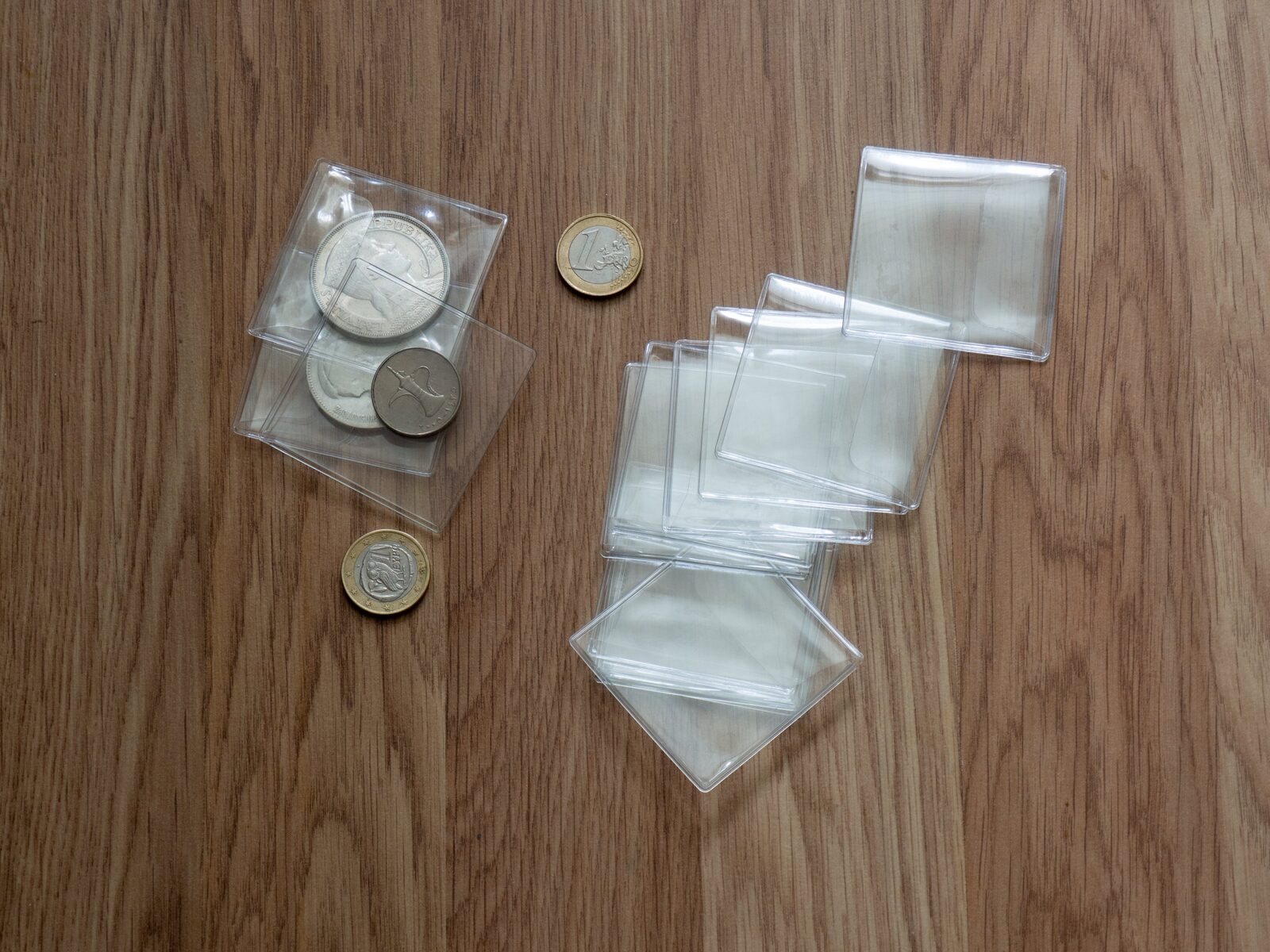
Which packaging suits which coin best is explained in Capsules, seals, slabs and sleeves explained.
How AgAurium helps
If you want to touch a coin as little as possible, you don’t want to keep taking everything out of the box just to see what you have. In AgAurium you record the details of each coin or bar: metal, fineness, weight, year, manufacturer and packaging (none, seal, capsule or sleeve), with a photo of the front and back. You can also note where the item is kept, for example “coin tube 3” or “safe”.
The photos show what condition the coin was in when you bought it. If a spot appears later, you’ll see the difference straight away. For gold, silver, platinum and palladium, AgAurium calculates the value at the current spot price, without you having to touch the coin.
AgAurium is free and ad-free. It keeps going thanks to voluntary donations.
Keep track of your collection with AgAurium
Coins, bars, banknotes, stamps and jewellery in one overview, with photos, live metal prices and proofs of purchase. Free, without ads, in English, Dutch and German. Your data stays yours.