
A 10 gram gold ring almost never contains 10 grams of gold. And a 1 ounce gold coin of 22 karat, such as the Krugerrand, weighs more than 1 ounce. To know what your precious metal is worth, you need to understand three terms: gross weight, fineness and fine weight. With gold, there is also karat.
Gross weight, fineness and fine weight
- Gross weight is what the item weighs on the scales.
- Fineness is the proportion of that weight that is precious metal. It is usually expressed in parts per thousand: 999 means 999 parts out of 1000, so 99.9%.
- Fine weight is the amount of pure precious metal in the item. That is what you are paying for when you look at the metal value.
The formula is simple:
fine weight = gross weight × fineness ÷ 1000
Example: a Krugerrand weighs 33.93 grams and has a fineness of 916.7. Its fine weight is 33.93 × 916.7 ÷ 1000 = 31.10 grams of gold, exactly 1 troy ounce. The rest is copper, which makes the coin harder and more resistant to scratches.
Troy ounces and grams
Precious metals are priced internationally per troy ounce. One troy ounce is 31.1035 grams. That is not the same as the ordinary ounce you find in recipes (28.35 grams). If you see “1 oz” on a coin or bar, it always means a troy ounce, and almost always refers to the fine weight.
Karat: gold in 24 parts
The purity of gold is often expressed in karat (abbreviated K or kt). Pure gold is 24 karat, and each karat stands for one twenty-fourth part. In Dutch, the same word “karaat” is used both for gold purity and for gemstone weight. In English the two are usually kept apart: karat for gold purity and carat (ct) for the weight of gemstones. More on that below.
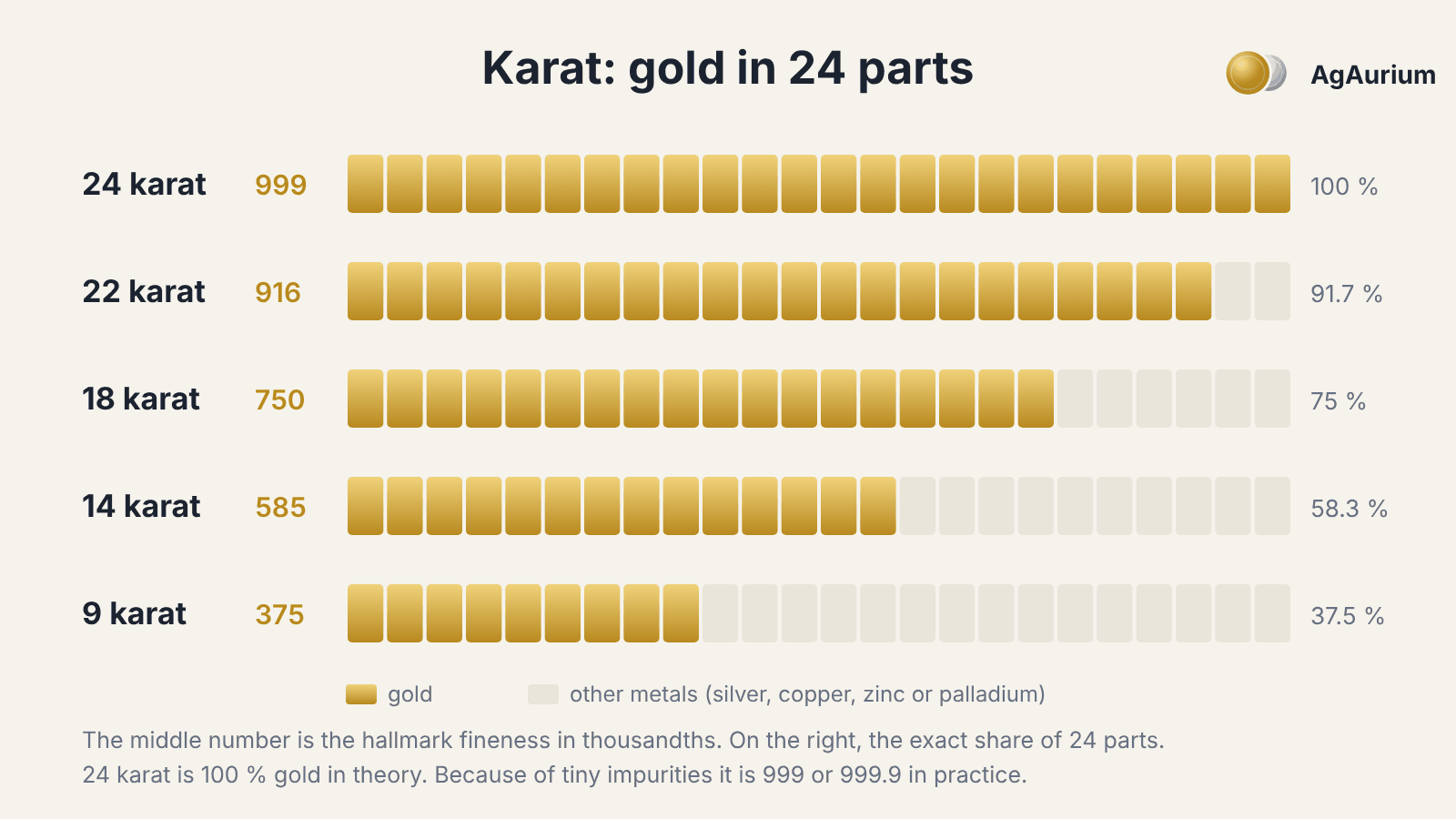
| Karat | Fineness (hallmark) | Gold content | Where you’ll see it |
|---|---|---|---|
| 24 karat | 999 | 99.9% | Bullion bars, many modern bullion coins |
| 22 karat | 916 | 91.7% | Krugerrand, Sovereign, American Eagle |
| 18 karat | 750 | 75% | Jewellery, watches |
| 14 karat | 585 | 58.5% | The most common jewellery in the Netherlands |
| 10 karat | 417 | 41.7% | Jewellery, especially in the US |
| 9 karat | 375 | 37.5% | Jewellery, especially in the United Kingdom |
| 8 karat | 333 | 33.3% | Jewellery, especially in Germany |
The conversion: fineness = karat ÷ 24 × 1000. So 18 karat is 18 ÷ 24 × 1000 = 750. The values in the table are the legal hallmark values, and these sometimes differ slightly from the exact twenty-fourths. For example, 14 karat is exactly 583.3 ‰, but the hallmark says 585: the legal value is set just a little higher.
What else is in the gold?
Pure gold is soft. For jewellery and many coins, it is therefore alloyed with other metals. These also determine the colour:
- Yellow gold: gold with silver and copper.
- Red or rose gold: gold with a relatively high proportion of copper.
- White gold: gold with palladium or nickel, often with a thin layer of rhodium for a white shine. Nickel can cause allergic reactions, which is why many jewellers use palladium.
- Green gold: gold with a lot of silver.
These other metals don’t count towards the gold value. A 14 karat ring is 41.5% something other than gold.
Tip: Don’t feel like doing the maths? Enter the weight and karat in AgAurium and the app works out the fineness, fine weight and current value for you. Try AgAurium for free →
Silver, platinum and palladium
Silver also comes in different finenesses:
- 999 for bullion coins and bars
- 958 for Britannia silver
- 925 (sterling) for jewellery and cutlery
- 945, 900, 835, 800 and 720 for older coins and silverware. The Dutch silver guilders from 1922 to 1967 and rijksdaalders (2½ guilder coins) from 1929 to 1966, for example, have a fineness of 720. Older silver guilders, from 1898 to 1917, have a fineness of 945.
For platinum and palladium you mainly see 999 or 999.5 for bars and coins, and 950 for jewellery.
Worked example: what is a ring worth?
Say you have a 14 karat ring weighing 5 grams, without a stone. And say gold costs €100 per gram (a round example figure; the real price changes every day).
- Fine weight: 5 × 585 ÷ 1000 = 2.93 grams of gold
- Metal value: 2.93 × €100 = €293
Two caveats:
- When you sell, you get less than the metal value. A buyer has to have the gold melted down and refined, and wants to make something on it. So you’ll receive a percentage of the metal value. Compare several buyers.
- A piece of jewellery can be worth more than its metal. For designer pieces, antiques or fine craftsmanship, the value to a collector is sometimes much higher than the melt value. Have such pieces appraised first.

Carat for gemstones is something else
Confusing but important: for gemstones, carat (ct) is a unit of weight, not a measure of purity. One carat is 0.2 grams. So a 0.5 ct diamond weighs 0.1 grams. If you weigh a piece of jewellery set with stones, the weight of the stones is included in the gross weight. For the metal value, subtract it, or ask a jeweller to weigh the metal separately.
Reading hallmarks
Most gold and silver jewellery carries a fineness mark, such as 375, 585, 750 or 925. You may also find a sponsor’s mark, an Assay Office mark, a date letter, or marks such as GP or GF that point to a thin layer of gold. Read what they all mean in Hallmarks on gold and silver.
AgAurium does the maths for you
You don’t have to do these calculations yourself. In AgAurium you enter the weight of each item (in grams or troy ounces) and the fineness. For gold you can also enter the karat. If you enter a common karat, such as 14 or 18, AgAurium fills in the hallmark value (585 or 750). You can also enter the stamped fineness directly. AgAurium calculates the fine weight and, using the current spot price of gold, silver, platinum or palladium, the current value. You can also see your profit or loss compared with your purchase price.
For jewellery, you record for each stone or pearl what type it is, how many there are, the weight in carats, the cut, colour and clarity. As the weight, enter the weight of the metal without the stones: AgAurium calculates the fine weight from weight × fineness and does not subtract the stones itself. That way you keep metal and stones neatly apart. At the bottom of the overview you can see the total weight of your gold and your silver items for the selection shown. That is the gross weight, so including other metals in the alloy.
AgAurium is free and ad-free, and is made possible by donations.
Keep track of your collection with AgAurium
Coins, bars, banknotes, stamps and jewellery in one overview, with photos, live metal prices and proofs of purchase. Free, without ads, in English, Dutch and German. Your data stays yours.